Below you’ll find answers to some of the questions we are most often asked about Ayahuasca, our retreats, preparation and what to expect. If your question isn’t here, feel free to contact us.
Frequently Asked Questions
About Ayahuasca and Huachuma
What is Ayahuasca?
Ayahuasca is a psychoactive plant brew with deep roots in the Indigenous traditions of the Amazon. For generations, people have worked with it in ceremonies for healing, spiritual exploration and guidance.
An Ayahuasca ceremony can open up an unfamiliar way of experiencing yourself and the world. Memories, feelings and patterns may become vivid in ways that go beyond thinking or talking about them. There can be beauty, tenderness, grief, laughter, or a sense of connection that is difficult to put into words.
For us, this is part of what makes working with Ayahuasca meaningful: the possibility of encountering something familiar from a completely different place. Something you have understood for years may suddenly become something you can feel.
These experiences can also be demanding, both emotionally and physically. At Ancient Mother, we give a lot of attention to preparation, screening, the setting and the people beside you, so there is room for exploration, with attentive and professional support throughout.
What does an Ayahuasca experience feel like?
It is quite difficult to describe an Ayahuasca experience in a way that does it justice. Music may feel extraordinarily alive. A memory may return with unexpected tenderness. You might laugh, cry, see vivid imagery, or feel a deep affection for people you only met that afternoon.
Sometimes there is a sense of wonder, of discovering something new in yourself or remembering something you had almost forgotten. At other times, the experience is quieter: a feeling, a moment of stillness, or a small shift in how you see something.
There can also be fear, confusion, nausea or physical discomfort. A ceremony may move through several very different moments, and some of them can be hard to navigate.
You don’t need to know beforehand how to do any of this. You have your own space, the music helps shape the ceremony, and our guides are there to offer attention, grounding, reassurance and practical support when you need it.
You are welcome to arrive curious, hopeful, nervous. Or a little of all three. All good.
What is Huachuma (San Pedro)?
Huachuma, also known as San Pedro, is a psychoactive cactus with a long history of ceremonial use in the Andes. Its main psychoactive compound is mescaline.
People often describe a heightened connection with nature, their bodies and the people around them. Colours, music and ordinary details can take on an unexpected richness. A walk, a conversation or simply sitting quietly outside may become something quite extraordinary.
In the traditions from which we have learned, Huachuma is approached as a plant teacher. We value the openness, curiosity and sense of connection that can emerge when working with it.
The experience lasts for many hours and can also be emotionally or physically demanding. We approach it with the same care and attention we bring to our Ayahuasca ceremonies.
What is the difference between Ayahuasca and Huachuma?
Ayahuasca often draws your attention inward. Memories, emotions and imagery may become vivid, and your familiar way of experiencing yourself can change quite profoundly.
Huachuma is often experienced as more outward-facing. Your surroundings, the people beside you, music and movement may become part of the exploration. There can be a lovely sense of openness, playfulness and being fully present in the world. And a lot of fun too!
These are tendencies rather than fixed rules. Both medicines can bring depth, beauty and challenge.
We appreciate their different qualities. Each offers its own way of exploring, and the atmosphere of the ceremonies reflects that.
Why do you combine Ayahuasca and Huachuma in the 4-day retreat?
After two Ayahuasca ceremonies, stepping into a Huachuma day can feel like opening the windows.
The attention often moves outward, with space for nature, music, movement, conversation and silence. By then, we have also spent several days together. There is usually more familiarity, more ease, and sometimes the kind of laughter that only seems to happen after sharing something quite intense.
Things that arose during the previous ceremonies may appear in a different light. There can also be simple pleasure in being outside, spending time together and noticing what is around you.
We value Huachuma as a ceremony in its own right. Its different character brings something special to the final full day of our four-day retreat. And quite often it can really help starting the integration process.
Before the Retreat
How do I know if an Ayahuasca retreat is right for me?
People find their way here for all sorts of reasons. You may be moving through a difficult period, feeling curious about yourself, or sensing that something in your life deserves more attention. Sometimes there is a clear question. Sometimes there is simply a wish to explore.
Many guests share with us that they ‘simply heard the calling’.
You don’t need to have everything worked out before contacting us. We are happy to hear what brings you here and talk through your questions.
Your health, medication, circumstances and expectations also matter. Our intake process helps us consider together whether participating is appropriate for you at this moment.
Curiosity is a good place to begin. So is an honest conversation.
Are there medical conditions or medications that prevent me from participating?
Yes, absolutely. Ayahuasca can interact with certain medications and may be unsuitable for people with particular medical or psychiatric conditions. Before participating, everyone completes a health questionnaire so we can give these matters proper attention.
Please include all medication you use and any relevant physical or mental health history. Some answers may lead to a further conversation, a request for medical advice, or a recommendation not to participate.
You are welcome to contact us beforehand if you are unsure about something. We would much rather discuss a question with you than have you guess what matters.
Never stop or change prescribed medication in order to participate without consulting the doctor who prescribed it.
Do I need previous experience with psychedelics?
No. Many people arrive for their first experience, and we know that taking that step can feel both exciting and rather daunting.
You don’t need special knowledge, a meditation practice or a particular spiritual outlook. Before you arrive, we explain how to prepare and what happens during the retreat. During the ceremonies, our guides remain present to offer support.
If you are nervous, please tell us. You will almost certainly not be the only one!
Previous experience is welcome too, of course. Each ceremony can have its own character, even when you have worked with Ayahuasca (many times) before.
What happens after I apply?
You will receive an email explaining the next steps, including a link to our intake form. This asks about your health, medication, previous experiences and anything else we should know before welcoming you.
Please complete it as soon as you can. It helps us prepare for your arrival and gives us time to discuss any questions with you well before the retreat.
We review your answers and contact you if anything needs further attention. Your place remains subject to that review, even if we have already been in touch about dates or payment.
We will also send you practical information about your stay and how to prepare. If anything feels unclear along the way, you can simply reply and ask. There are no silly questions!
How should I prepare for the retreat?
A little (head)space before the retreat can be a lovely way to begin.
In the week beforehand, we encourage you to eat light, simple meals, avoid alcohol and recreational drugs, and take good care of yourself. You will receive our detailed preparation guidelines, including specific information about food, substances and supplements.
Preparation can also mean slowing down a little. A walk in nature, an earlier night, less time with the news or your phone, or a quiet moment to consider what brings you here.
You don’t need to arrive perfectly calm or with a beautifully worded intention. There is room for excitement, uncertainty and whatever else you bring.
Please disclose all medication during the intake. Never stop or change prescribed medication yourself in order to participate.
Do I need to follow a special diet before the retreat?
We ask you to follow the preparation guidelines we send before your retreat. These explain what to eat and which foods, drinks and substances to avoid.
There is also something valuable in giving yourself a little more attention before you arrive. Preparing simple meals, eating consciously and slowing down can help you make room for the days ahead.
You don’t need to turn preparation into a test of discipline or worry that one imperfect meal will determine your experience. If you are uncertain about something in the guidelines, please ask us.
Medication needs separate attention and should always be discussed during the intake.
During the Retreat
What happens during an Ayahuasca ceremony?
We begin in the afternoon, gathering together in the ceremony space. Once everyone has settled, and we’ve discussed whatever is relevant to the process, each participant is offered Ayahuasca individually.
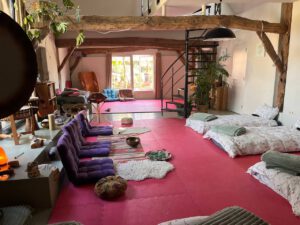
You have your own mattress and space. Music is an important part of the ceremony, with live and recorded music as well as moments of silence. Our guides remain present throughout, attentive to the room and to each person. Ceremonies are not the place for long-winding conversations, but sometimes we can encourage and support you with words that suit the experience.
Much of the experience unfolds quietly within your own space. At other times, you may want reassurance, practical help or someone beside you. You can ask for support, and we also pay attention to when it may be needed.
There is room for tears, laughter, stillness and uncertainty. We ask everyone to treat each other’s experience with care and respect.
What if I become frightened or overwhelmed during a ceremony?
Please let us know. You don’t have to manage a difficult moment on your own. In most cases it will be clear to us anyway.
Ayahuasca can bring feelings or sensations that are unfamiliar and sometimes frightening. A guide can sit beside you, speak quietly with you, help you find your breathing or offer a steady presence while things unfold.
We also keep an eye on how everyone is doing, so support does not depend entirely on you finding the words to ask.
Our response depends on what is happening and what you need. We take distress seriously, and we don’t assume that someone should be left struggling simply because difficulty can be part of a ceremony.
What is ‘purging’, and will I vomit?
You might. Vomiting and diarrhoea can occur during an Ayahuasca ceremony, although some people experience little physical discomfort.
In many Ayahuasca traditions, these reactions are called purging and may be understood as a form of release. Some people experience that very strongly. Others simply feel sick or are completely fine. You don’t need to give it a particular meaning. And there are no T-shirts for Best Vomiting 🙂
You will have a bucket beside your mattress, toilets are nearby, and our guides can help when needed. We are very familiar with this part of the experience, so there is no need to feel embarrassed.
Vomiting is not a measure of how deeply you are experiencing the ceremony. There is nothing you need to achieve with your bucket.
What happens between the ceremonies?
There is time to land.
After breakfast, you can rest, walk, sit outside, talk with others or find a quiet corner for yourself. We leave plenty of open space in the day. A good meal, some sleep or a conversation in the garden can be as welcome as anything on a programme.
There are opportunities to share your experience with the group or speak with a guide. You can also let it settle without immediately finding words for it.
By the second ceremony, the setting and the people around you usually feel more familiar. That growing ease is one of the things we value about spending several days together. It always happens, but it never stops to feel special.
Do I have to share my experience with the group?
No. Sharing is always an invitation.
Hearing each other can be moving, reassuring and sometimes unexpectedly funny. You may recognise something of yourself in another person’s story, or discover what you feel while trying to put it into words.
You are equally welcome to listen. Some experiences need time, and some things you may prefer to keep private or discuss individually with a guide.
We ask everyone to respect that freedom and each other’s confidentiality. What someone shares personally during the retreat should stay within the group.
After the Retreat
What is integration?
Integration is how the experience finds a place in your everyday life.
During a ceremony, something may become strikingly clear. You might feel more kindness towards yourself, see a familiar struggle differently, or discover how much you have missed a sense of connection. Back home, the question becomes: what does this mean while making breakfast, going to work, or being with the people you love?
Sometimes an experience leads to a significant change. Often it finds its way into smaller things: an honest conversation, asking for help, taking more rest, or responding a little differently when an old pattern appears.
This takes time. As we sometimes say: the painting is still wet. Give it some time to dry. You can value what you experienced while allowing your understanding of it to develop.
At Ancient Mother, we begin that conversation during the retreat and return to it in your individual integration call afterwards. There is room to explore what touched you, what remains difficult, and what you would like to carry with you.
The ceremony may be over, but there can still be plenty to discover.
What support do you offer after the retreat?
On the final day, we take time to look back together and prepare for returning home. There is room for questions, reflections and a conversation about integration.
You can stay in touch afterwards if something comes up or you would like to talk. We also invite you to our WhatsApp community for former participants, where you can share experiences and remain connected.
After two to three weeks, we have an individual integration call. By then, you have had some time back in everyday life. We explore how you are doing, what has stayed with you and anything you would like to discuss.
If you need support beyond what we can offer, we will encourage you to contact an appropriate professional.
You are always welcome to reach out to us after your retreat.
How might I feel in the days after the retreat?
You may feel open, peaceful, tired, emotional or full of energy. Sometimes ordinary life looks a little different. Sometimes the first thing you need is a good night’s sleep.
Give yourself a gentle return if you can. Leave some space in your schedule, eat well, go outside and spend time with people whose company feels comfortable. Or stay on your own for a while.
You may want to talk about everything, or keep the experience close for a while. There is no need to rush to explain it or decide what it all means. Actually: we encourage you to keep things to yourself, and BE the change instead of talking about it.
If you feel unsettled or are struggling afterwards, please contact us so we can discuss what support may be helpful.
Should I make major life decisions after an Ayahuasca retreat?
A ceremony can bring a powerful sense of clarity. Something about your work, a relationship or the way you live may suddenly feel very obvious.
Take that seriously enough to give it time.
We generally recommend letting major decisions settle before acting on them. See how an insight feels after some rest and a few ordinary days. Talk it through with someone you trust, and notice what continues to feel true once the intensity has softened.
An experience can be valuable without requiring an immediate announcement, resignation or house move. There will be time to explore what you want to change.
As we sometimes say during integration: the painting is still wet. Give it some time to dry.
Practical Questions
Is there a shaman present during the retreat?
We don’t call ourselves shamans.
Our ceremonies are guided by experienced facilitators who have worked extensively with these medicines. Margriet trained in Peru and completed a traditional initiation that allows her to use the title curandera. Another member of our team has completed the same initiation.
We value those relationships, teachings and traditions. They are part of what we bring to the work, alongside our own experience and the people we are.
When you come here, we want you to meet us as people you can talk to and ask questions of. Our attention is on the ceremony, the group and the care each person needs.
How do I get to the venue?
Our retreat location is in the countryside of Drenthe, near Assen. We will send you the exact address and travel details before you arrive.
If you come by public transport, travel to Assen station. There are regular connections from Amsterdam and Schiphol Airport, with a journey time of around two hours. We can collect you from the station at the agreed time on the first day and bring you back after the retreat.
If you drive, you can come straight to the venue and park there.
Let us know how you plan to travel so we can help the arrival go smoothly.
Can I come alone?
Absolutely. Most people do.
You don’t need to bring someone with you to feel welcome here. We have time to meet, settle in and get to know each other before the first ceremony.
Sharing a few days, meals and ceremonies often creates a lovely sense of familiarity. There is also plenty of room to be quiet or spend time on your own. You don’t need to be particularly outgoing.
Coming alone can give you the freedom to pay attention to your own experience. And by the time you leave, the people who were strangers on the first afternoon may feel rather different and really close.
Can I bring my partner or friends?
Yes, of course. Partners, friends and family members can join the same retreat, provided everyone registers separately and completes the intake process.
It can be lovely to share these days with someone close to you. That said, it is also worth considering how their presence might affect your experience. You may find yourself wondering how they are doing or feeling responsible for them, and that’s not always helpful.
We encourage each person to have space for their own ceremony. For that reason, we generally recommend that partners and friends do not lie beside each other during the ceremonies.
There is plenty of time outside the ceremonies to be together and share what you wish. If you are unsure whether to come together, we are happy to talk it through.
What if I have to cancel my retreat?
Please let us know as soon as you can. We understand that circumstances change, and an early conversation gives us more room to work out what is possible.
Our groups are small, so a cancellation can make a real difference, particularly close to the retreat date. Deposits are non-refundable. Depending on how far in advance you cancel, it may be possible to transfer part of your payment to another date.
You will receive the applicable payment and cancellation terms with your booking information.
If you already have doubts about whether you can attend, please discuss them with us before reserving a place.
What is included in the price?
Your stay includes accommodation, all meals and drinks, the ceremonies and medicine, preparation information, guidance throughout the retreat and our integration support afterwards.
We provide what you need in the ceremony space, so you don’t have to arrive with special equipment (although some guests bring their favorite pillow). Bring comfortable clothes and your personal belongings. We take care of the meals and the setting.
Travel is not included, but we can collect you from Assen station at the agreed time and bring you back at the end.
There are no additional costs during your stay.
What are the sleeping arrangements?
Participants sleep in the shared ceremony space during the retreat.
It is a simple, communal arrangement, and we want you to know that beforehand so you can consider whether it suits you. We don’t offer private bedrooms as part of the retreat.
If you travel with a camper or motorhome, it may be possible to sleep in your own vehicle. Please discuss this with us in advance.
If you would like to arrive earlier or stay an extra night afterwards, we can arrange a separate room. Contact us to discuss availability and the practical details.
What should I bring to the retreat?
Bring clothes you feel comfortable in, including warm layers and suitable shoes for spending time outside. A water bottle, notebook and pen are useful too. Bring a swimsuit if you would like to use the sauna.
For the ceremonies, we prefer white or light clothing because it brings a sense of visual calm to the room. It is a preference, so there is no need to go shopping for a special outfit.
You are welcome to bring a photograph or a small personal object that means something to you. Some people like having something familiar beside them.
We will send you practical details before you arrive.
How many people are in a retreat?
Our groups usually have between seven and twelve participants.
We enjoy the intimacy of a small group. There is room to get to know each other, share meals and conversations, and still find your own quiet space.
It also allows us to give personal attention during the ceremonies. We want to know who is in the room and have time for the people who have come to spend these days with us.
The exact number varies from retreat to retreat.
Can you accommodate dietary requirements?
Yes. We serve vegetarian meals and can usually accommodate common dietary requirements and allergies.
Please tell us what you need in your intake form, so we can plan the meals with you in mind. If you have a serious food allergy or a particularly restrictive diet, contact us beforehand to discuss what we can offer.
Food is a welcome part of the time between ceremonies. We want you to be able to sit down, enjoy your meal and feel well looked after.
What language is the retreat in?
We mainly speak English during group conversations and guidance, as people join us from different countries.
We also speak Dutch, and you are welcome to use it in individual conversations or when asking for support.
Your English doesn’t need to be perfect. You do need to understand the general guidance and practical information, but nobody is expecting a polished account of your inner world. Finding words for an experience can be difficult enough in your own language.
If you are concerned about language, get in touch and we can discuss it.